


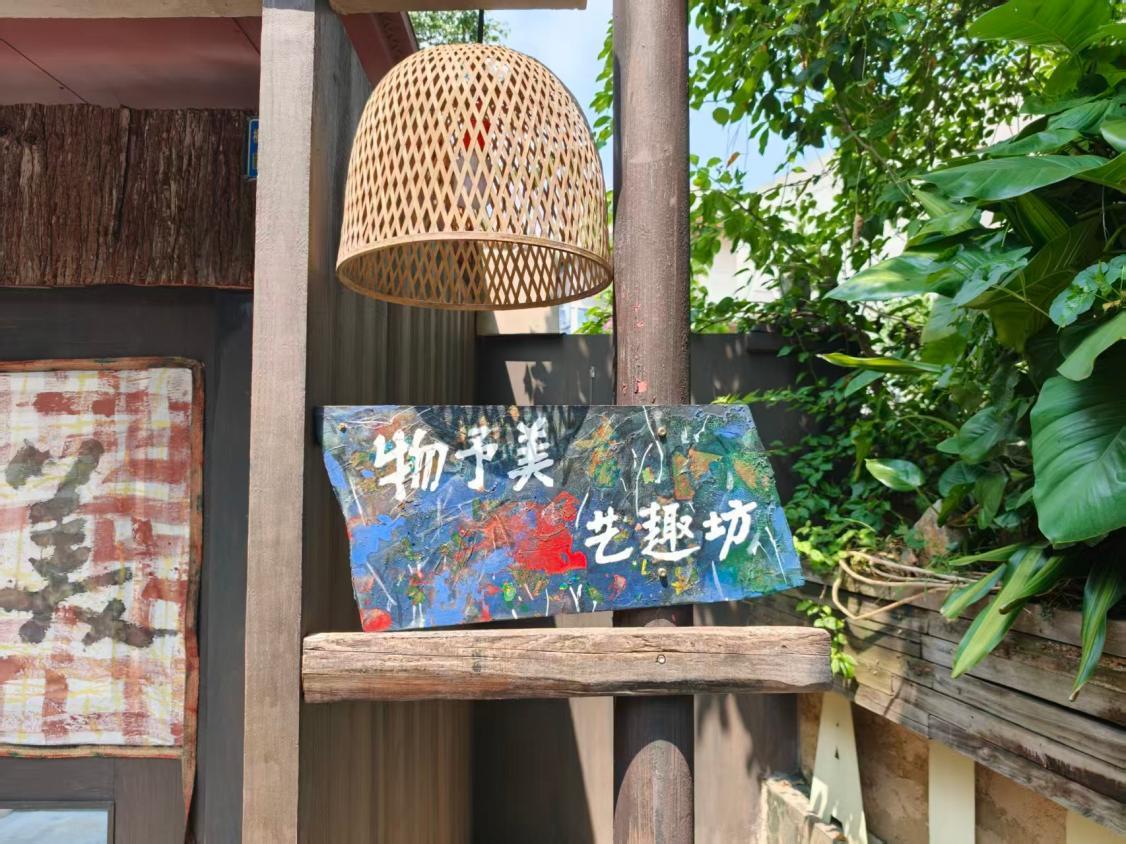
In Hengli, Dongguan, a creative studio called Wuyumei (物予美, “Things Given Beauty”) has become a place where people with no painting experience often finish their first hand-painted work. Some paint distant mountains on plain white T-shirts. Others draw lotus flowers on coasters or turn canvas bags into personal statements. Here, art is not treated as a gift reserved for the talented but as a natural human urge to express oneself.
Behind this small studio is a century-long story of four generations of the Zheng family and their relationship with painting. The medium has changed repeatedly—from traditional paper to industrial materials, from architectural surfaces to everyday clothing—and with each change, the family’s artistic tradition has taken a different form. Now, in the fourth generation, Zheng Yutong (郑寓桐) is carrying that legacy into the lives of ordinary people, putting the brush directly in their hands.
The Scholar’s Brush: Where a Century of Artistic Tradition Began
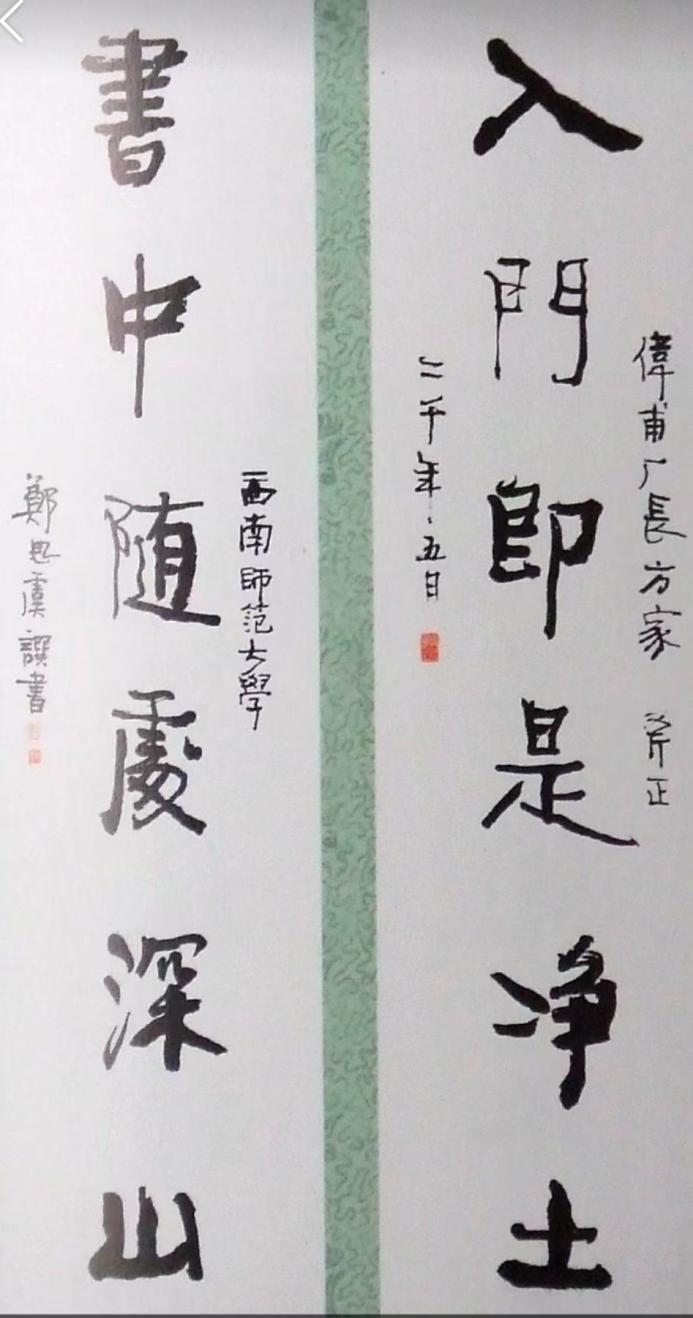
The family’s artistic heritage begins with Zheng Siyu (郑思虞), a scholar, calligrapher, and painter who devoted much of his life to Chinese painting.
Although respected for his research on the Book of Songs, one of China’s oldest poetry collections, Zheng was perhaps best known for the world he created with his brush. His freehand paintings of figures, landscapes, flowers and birds were marked by economical brushwork and unusual depth of expression. His calligraphy drew heavily on Han and Wei stone inscriptions, giving his characters a distinctive, unconventional structure. Poetry, painting and calligraphy came together in a style entirely his own.
For Zheng Siyu, painting was inseparable from learning. He spoke several foreign languages and drew on a wide range of intellectual interests, all of which informed his art. Fame and material success held little appeal for him.
“Within books, one can always find a retreat among the mountains; stepping through the door is like entering a sanctuary.”
The words captured both his approach to scholarship and the ideals he pursued throughout his life.
Zheng spent his lifetime painting and teaching. What he passed down was far more than a set of techniques. It was a belief that painting demanded years of patient study and personal discipline, and that an artist’s work should reflect the integrity of their character.
That philosophy became the foundation of the Zheng family’s artistic tradition.
Building Beauty to Last: Materials Science and the Family’s Inherited Values
Zheng Siyu expressed beauty on paper. His son, Zheng Shu (郑述), set out to give it a more durable foundation.
An expert in abrasives, grinding technology, and superhard materials, Zheng Shu received a special allowance from the State Council in recognition of his professional contributions. He spent decades studying materials and developing new manufacturing technologies.
In 1995, he was granted a national invention patent for his blue corundum manufacturing technology. He also pioneered a firing-free glaze technology that was applied in the construction industry and later adopted by major property developers.
After retiring, Zheng moved south to Shenzhen to start a second business, turning decades of technical knowledge into commercially viable products.
For him, materials science was another way to solve problems affecting buildings—and another way to create beauty. His work focused on some of the most persistent challenges in construction: preventing colors from fading or peeling, keeping walls from cracking, and ensuring that buildings could withstand the passage of time.
At the heart of these efforts was the challenge of improving architectural surfaces.
Zheng rarely spoke about art itself, yet his work addressed something essential to its lasting existence. Architecture is often described as an art form in its own right, but even the most beautiful design depends on reliable materials to endure.
In this way, Zheng Shu gave the family’s artistic tradition a new dimension, one grounded in scientific research and practical application.
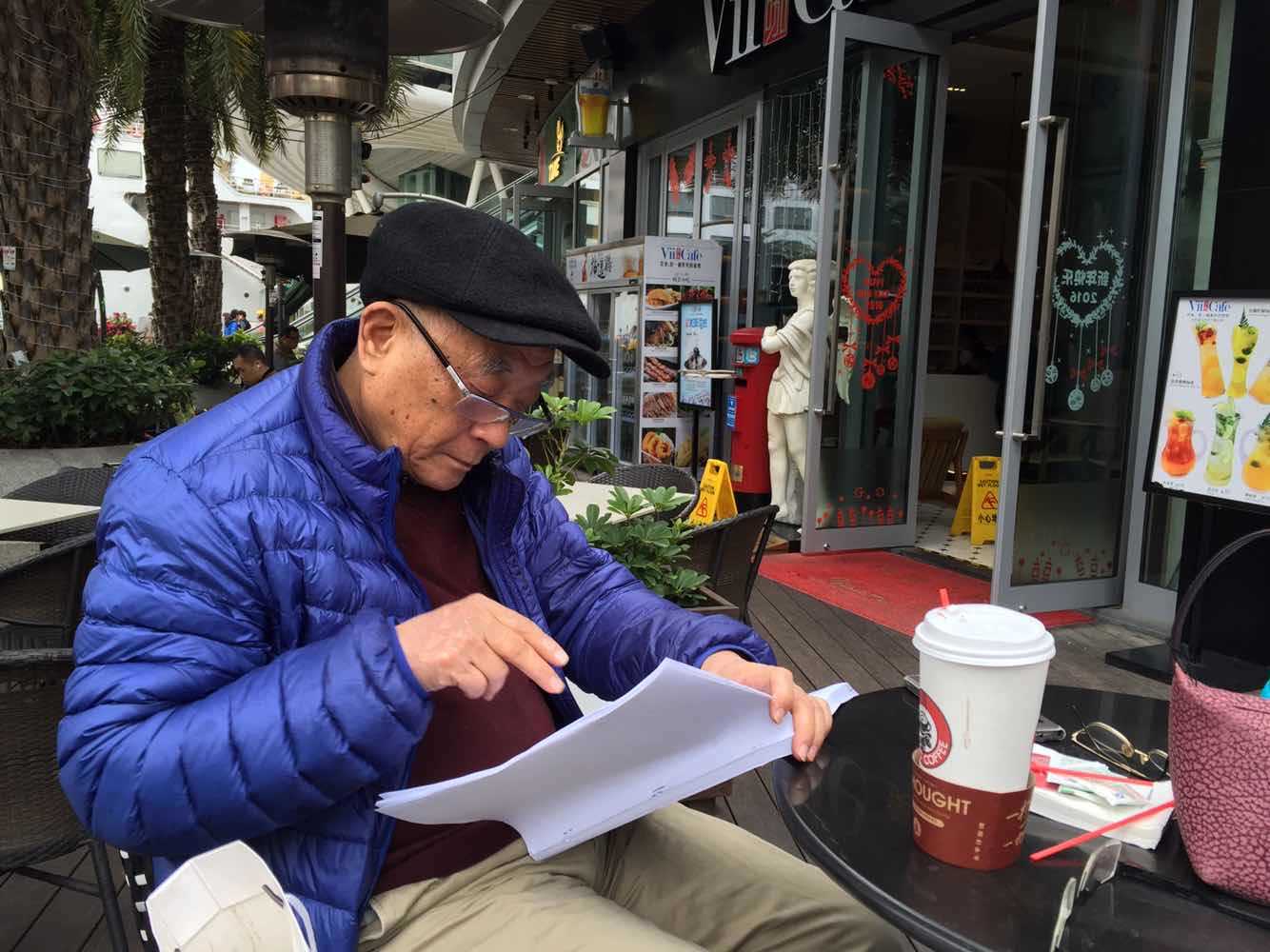
Photo: Zheng Shu, an expert in abrasives, grinding technology, and superhard materials.
From Canvas to Construction: When Painting Entered the Production Line
The next person to carry the family’s legacy forward was Zheng Yuanting (郑元廷). Among the first three generations, his career took perhaps the most dramatic turn—from oil painter to entrepreneur in the building materials industry.
Yuanting began learning to paint at the age of five under the guidance of his grandfather, Zheng Siyu. He later graduated from the Oil Painting Department of the Sichuan Fine Arts Institute and initially pursued a career as a professional artist.
In 2001, he left his job in Chongqing and headed south to join his father in business.
In a sense, he moved his easel onto the factory floor.
Drawing on his training in oil painting—particularly his understanding of color, texture, and composition—Zheng Yuanting began incorporating artistic principles into the research and development of construction materials.
His efforts eventually led to a new type of building panel that could be formed at room temperature without kiln firing or sintering. The production process generated relatively low carbon emissions, while the finished panels reproduced the textures and colors of natural stone.
The panels were subsequently used in projects with several major Chinese property developers, including Poly, AVIC, Vanke and China Merchants.
In 2018, a national industry standard for which Zheng Yuanting served as lead drafter was officially issued by China’s Ministry of Housing and Urban-Rural Development and implemented nationwide.
“I can paint among entrepreneurs, and I can run a business among painters,” Zheng Yuanting often says when describing himself.
To him, almost any discarded material could become a surface for artistic expression.
Around 2005, he gradually shifted his focus toward what he called “artistic building materials.” Inspired by the visual language of ancient rock paintings and the murals of Dunhuang, he began experimenting with colors and textures on different material surfaces.
The resulting patterns were never exactly alike. He named this artistic approach “Rock-State New Chinese Art” (岩态新国艺, Yantai Xin Guoyi; here yantai means “rock state,” not the city of Yantai).
At the 2010 China Hi-Tech Fair, Zheng recreated a three-meter-tall version of Piet Mondrian’s Composition using his specially developed panels.
That same year, the panels were selected as designated building materials for the London Zero Carbon Pavilion at the Shanghai World Expo.
For Zheng Yuanting, the relationship between art and business has always been natural.
“Art is a game for the wise. It brings people the joy of discovery and the pleasure of new ideas. It requires constant creativity and exploration. Running a business is much the same,” he says.
“The farther you can see, the farther you can go.”
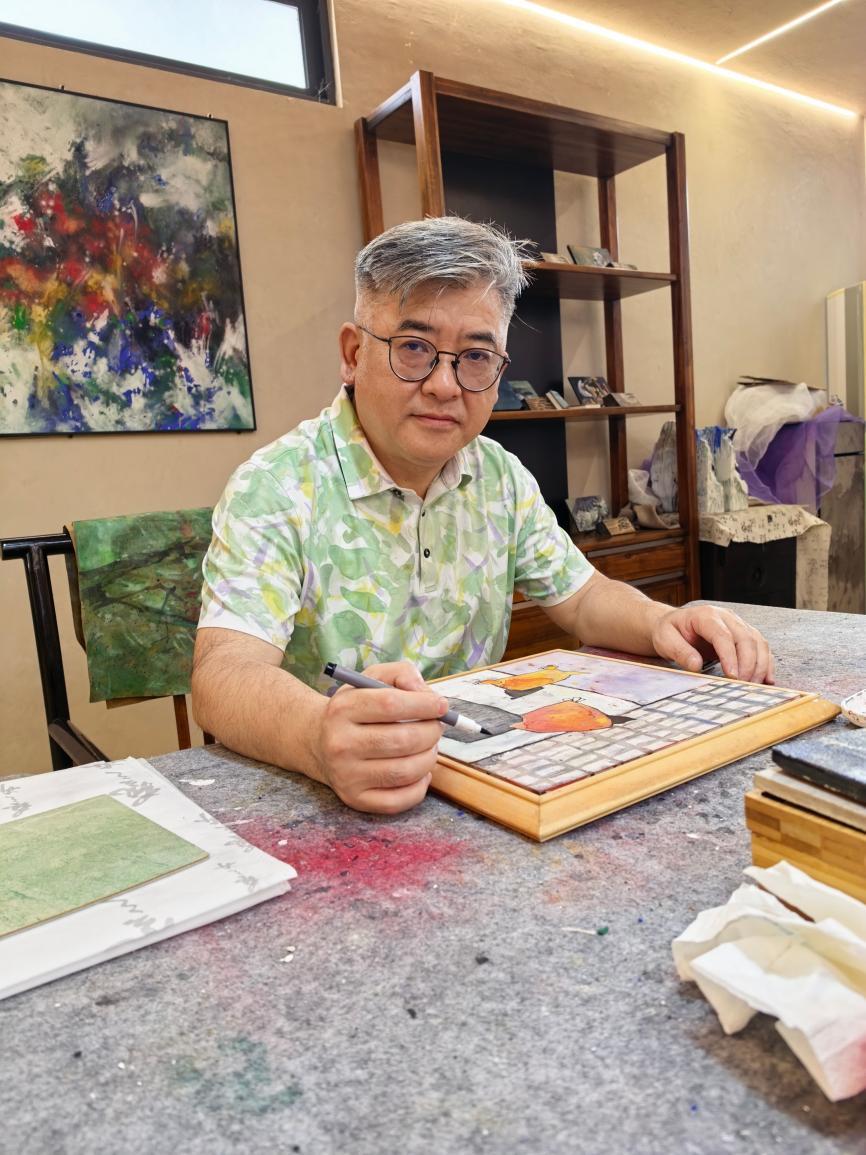
Photo: Zheng Yuanting, lead developer of high-tech firing-free glaze pigments.
From Showrooms to Everyday Life: Putting the Brush into Everyone’s Hands
The fourth generation’s contribution to the family tradition began with a simple experiment.
While applying to some of the world’s leading art schools, Zheng Yutong designed a pair of modular basketball shoes with leather uppers for his portfolio.
Having loved painting since childhood, he wanted to create a pair of shoes that reflected his own artistic ideas.
He took some of the experimental firing-free glaze pigment developed by his family and began painting directly onto the leather.
At the time, the pigment did not even have a name. It was simply a new material that his father and grandfather had spent years developing and refining.
What surprised Yutong was how well it worked. Once the color had settled onto the leather, it could not be washed away.
The result exceeded his expectations. The portfolio featuring his design helped him secure offers from several prestigious art schools overseas.
Two different approaches to education shaped his artistic outlook.
At home, his father taught him the fundamentals of drawing through observation, sketching, and repeated practice. Every line was an exercise in developing technique and understanding form.
His teachers abroad encouraged a different kind of thinking. Students might visit a museum to study how a tiger crouched or moved while hunting, then use those observations as inspiration to design a chair or a plate.
These contrasting experiences left a lasting impression on him.
In his view, painting is not something that can be reproduced. Every person sees the world differently, and every artistic expression is unique.
That belief in creating something from nothing later became central to his work with pigments and painting tools.
Drawing on his education, contemporary lifestyles and an international perspective, Zheng Yutong began rethinking how the family’s materials could be developed into products for modern consumers.
He refined their packaging, visual identity and practical applications, gradually developing coordinated ranges of pens, inks and pigments designed for different purposes and settings.
But the possibility of bringing these materials to the wider public was built on the work of several generations.
Zheng Shu had devoted much of his life to developing firing-free glaze materials. The core technology behind the new pigments, known as high-penetration crystallization technology, rested on the expertise he had accumulated over decades.
Zheng Yuanting then found ways to adapt materials originally developed for industrial use to everyday applications.
Finally, Zheng Yutong took the next step, transforming those materials into products that ordinary people could use.
He also designed a matching range of markers.
The five-color marker set draws inspiration from the tonal qualities of ink in traditional Chinese painting. Yutong was personally responsible for both the packaging and graphic design.
Unlike conventional markers, these pens can be used on almost any surface apart from plastic. Once dry, the colors are resistant to washing and can be applied to clothing, leather goods, ceramics, and wood.
According to Zheng Yutong, most markers on the market are primarily designed for paper and rely on alcohol-based solvents, which can produce a strong smell.
His family’s ink, by contrast, is water-based. He says that several of its safety indicators are well within the limits set by European Union standards, making it suitable even for children who want to paint on their clothes.
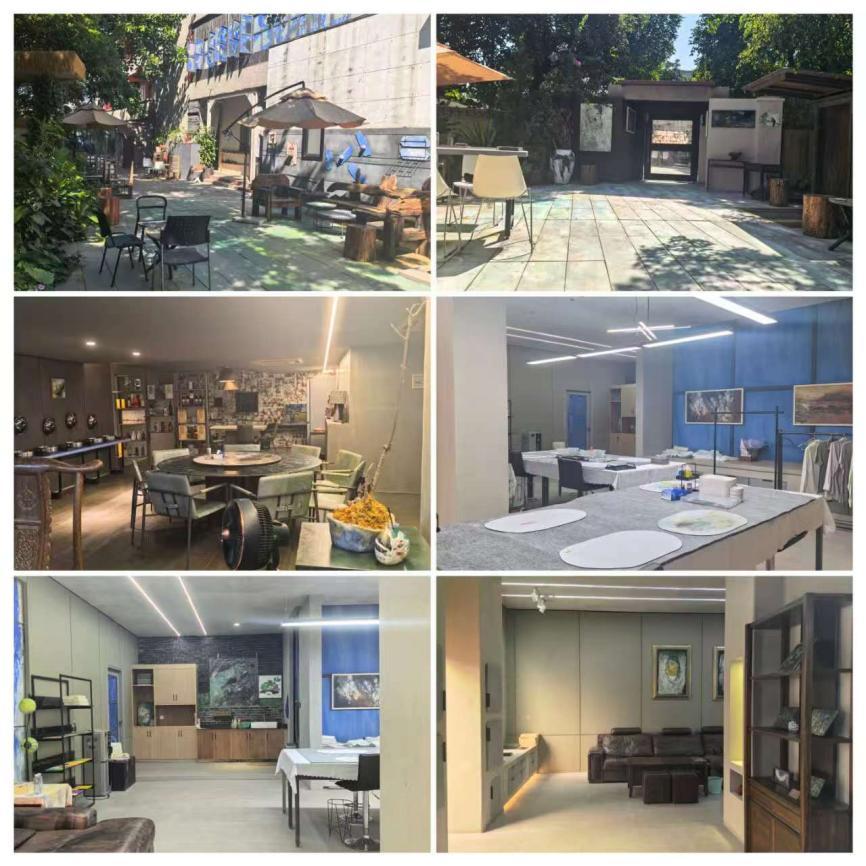
The Wuyumei studio in Hengli, Dongguan, is the latest place where these materials have found a practical use.
The studio had been open for less than a month, but it was already introducing visitors to a different kind of painting experience.
There is no need for an easel, a traditional canvas, or years of artistic training.
Visitors can paint directly onto mineral-based boards, turning ordinary coasters and tea trays into decorative objects that can be used once dry. They can personalize T-shirts and scarves with their own designs, creating pieces that no one else owns.
Old clothes can also be transformed rather than thrown away, giving garments with sentimental value a new place in someone’s wardrobe.
Customers are welcome to pick up a pen whenever they wish. Once their artwork is finished, they can take it home.
Within the studio’s first month, visitors from Hong Kong have already begun making special trips to experience it.
Some arrived with old silk scarves they wanted to redesign. The results were occasionally so impressive that even Zheng Yuanting admitted he could hardly have done better himself.
For the Zheng family, the studio represents both a continuation of its heritage and the beginning of a new chapter.
Zheng Siyu established the family’s artistic foundations. Zheng Shu developed materials that made color more durable and reliable. Zheng Yuanting brought artistic expression beyond paper and into architectural materials, demonstrating that beauty could become part of everyday surroundings through technological innovation.
Now, Zheng Yutong has taken the family’s pigments and painting tools to market, making them accessible to ordinary people for the first time.
In the past, the Zheng family’s art was something people encountered on a wall or as part of a building. Most could only look at it.
Today, they can participate in creating it themselves.
For those who walk into Wuyumei, art is no longer something to be admired from a distance, behind the glass of a museum display.
Zheng Yutong believes that many people mistakenly judge a painting by how closely it resembles reality. For him, art is about expressing what is inside a person. It should satisfy the individual creating it, rather than the expectations of others.
“If you think it looks beautiful, then it is beautiful,” he says.
He points to Pablo Picasso as an example. Picasso’s early works were highly realistic, but his later paintings moved increasingly toward abstraction as he sought to recover the spontaneity and freedom of expression associated with childhood.
For Yutong, this illustrates a simple idea: art is a way of expressing one’s inner world.
Anyone holding a brush can become an artist in their own right.
Zheng Yuanting shares that outlook.
He often argues that artists should not present themselves as distant or inaccessible figures.
“I would rather make art something everyone can take part in,” he says. “Once you make it too specialized, a lot of people are simply left out.”
On the sign outside the studio are three Chinese words, rendered in English here as:
Art · Materials · Everyday Life
Together, they sum up the answer that four generations of the Zheng family have arrived at, as well as the direction Zheng Yutong hopes to pursue.
He is now overseeing the design and promotion of Youyishi (釉一石, “Glaze-One-Stone”), the family’s new pigment brand, to introduce its products into more people’s daily lives.
“Our ultimate goal is to take the business beyond China and bring it to overseas markets,” he says.
What he wants is simple: for more ordinary people to discover that, with a pen, a cup of water and a T-shirt, they can create something that belongs entirely to them.
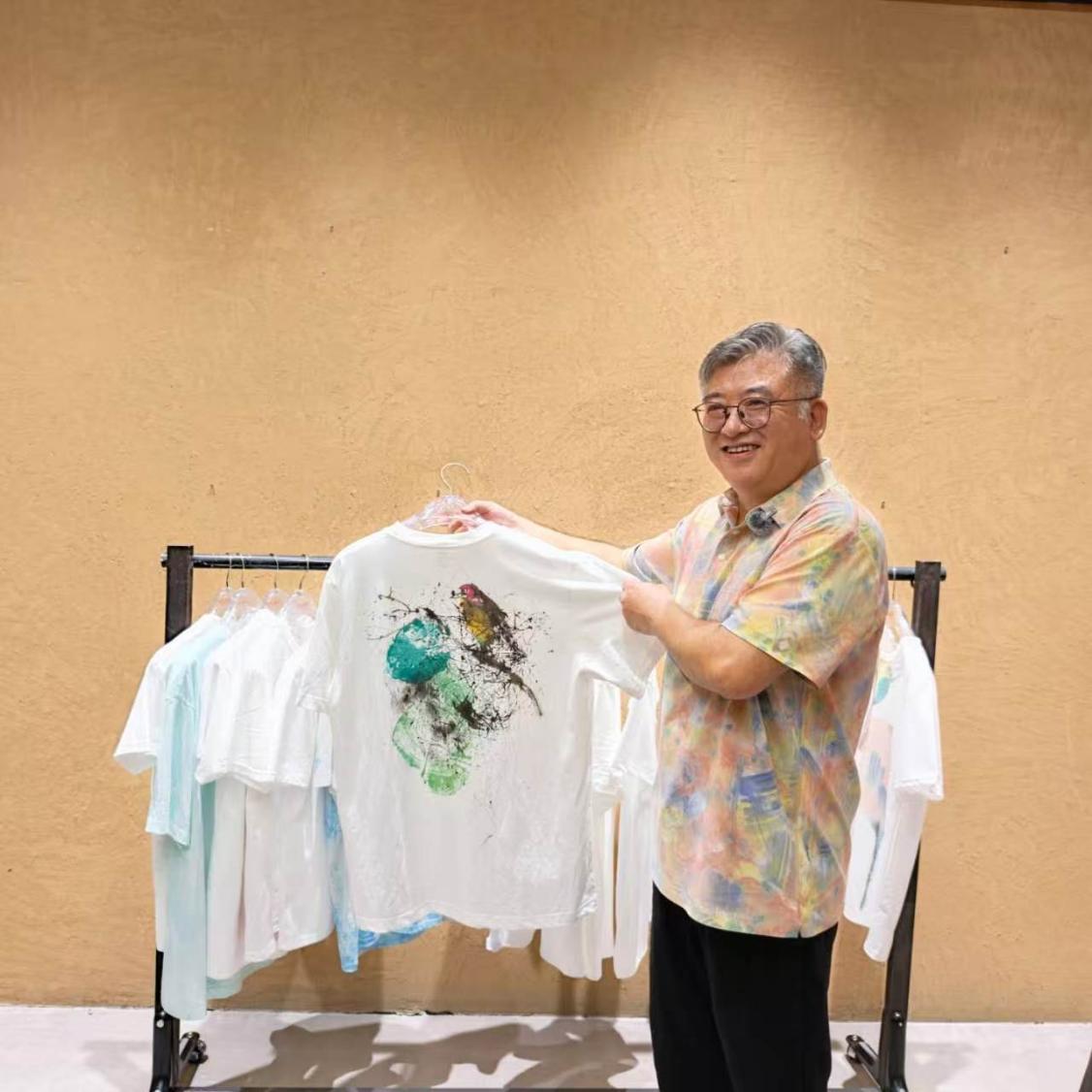
Four Generations, One Century of Art
Looking back over the Zheng family’s century-long story, one thread runs through every generation.
The medium has changed, but the pursuit of beauty has remained.
Zheng Siyu used the courtesy name Shiyu (石愚), which contains the Chinese character for stone.
His son, Zheng Shu, dedicated his career to the study of inorganic materials.
Zheng Yuanting developed methods for turning discarded construction materials into panels that could serve as painting surfaces.
Now, the fourth generation has named its pigment brand Youyishi (釉一石), once again incorporating the character for stone into the family story.
From the courtesy name Shiyu to the brand name Youyishi, the same character has quietly connected the family’s artistic and scientific pursuits across generations.
The materials have evolved, and the audience has grown, but the underlying commitment to art has endured.
To the Zheng family, passing down a tradition does not mean reproducing the work of the previous generation. It means finding new places, new materials, and new people through which beauty can continue to exist.
From the ink and brushes of a scholar’s study to consumer-market products, the family’s artistic legacy has not faded with time. If anything, each generation has given it new life.
The greatest barrier to making art has never been a lack of skill. It is often the belief that art belongs to someone else.
As evening falls over Hengli, the lights are still on inside the Wuyumei studio.
Visitors sit painting distant mountains and lotus flowers, turning the tiredness of an ordinary day into something personal and expressive.
When someone leaves carrying a T-shirt they have painted with their own hands, a century of the Zheng family’s artistic heritage finds a place in the modern marketplace.
And art, once again, returns to the people.
The brush continues to pass from one generation to the next.
Just as Zheng Siyu was still writing poetry and painting at the age of one hundred, the Zheng family’s artistic story is far from finished.
Edited by Cheng Kaiwei, Zhang Haoyang (Intern)
Reviewed by Lin Zihao